There was a time, not so long ago, when buying a poshak meant a trip to the lanes of Mathura or Vrindavan, or perhaps to the small cluster of religious goods shops in your own city. You could feel the fabric between your fingers, hold it up to the light, and watch the silk catch a shimmer that no photograph can quite replicate. That direct, sensory certainty is something no online catalogue can fully replace — and I say that as someone who makes poshak with her own hands and has watched the shift happen. But I also know what online shopping genuinely offers that those narrow lanes never could: access to handcrafted poshak from artisans across the country, the freedom to browse at midnight when the house is quiet and the mandir lamp is still burning, and a level of variety in fabric, style, and size that would take weeks of travel to match in person. Buying poshak for your Laddu Gopal online is not an inferior choice. It simply requires a different kind of attention — and that is exactly what this guide is about.
The Sizing Problem and How to Solve It
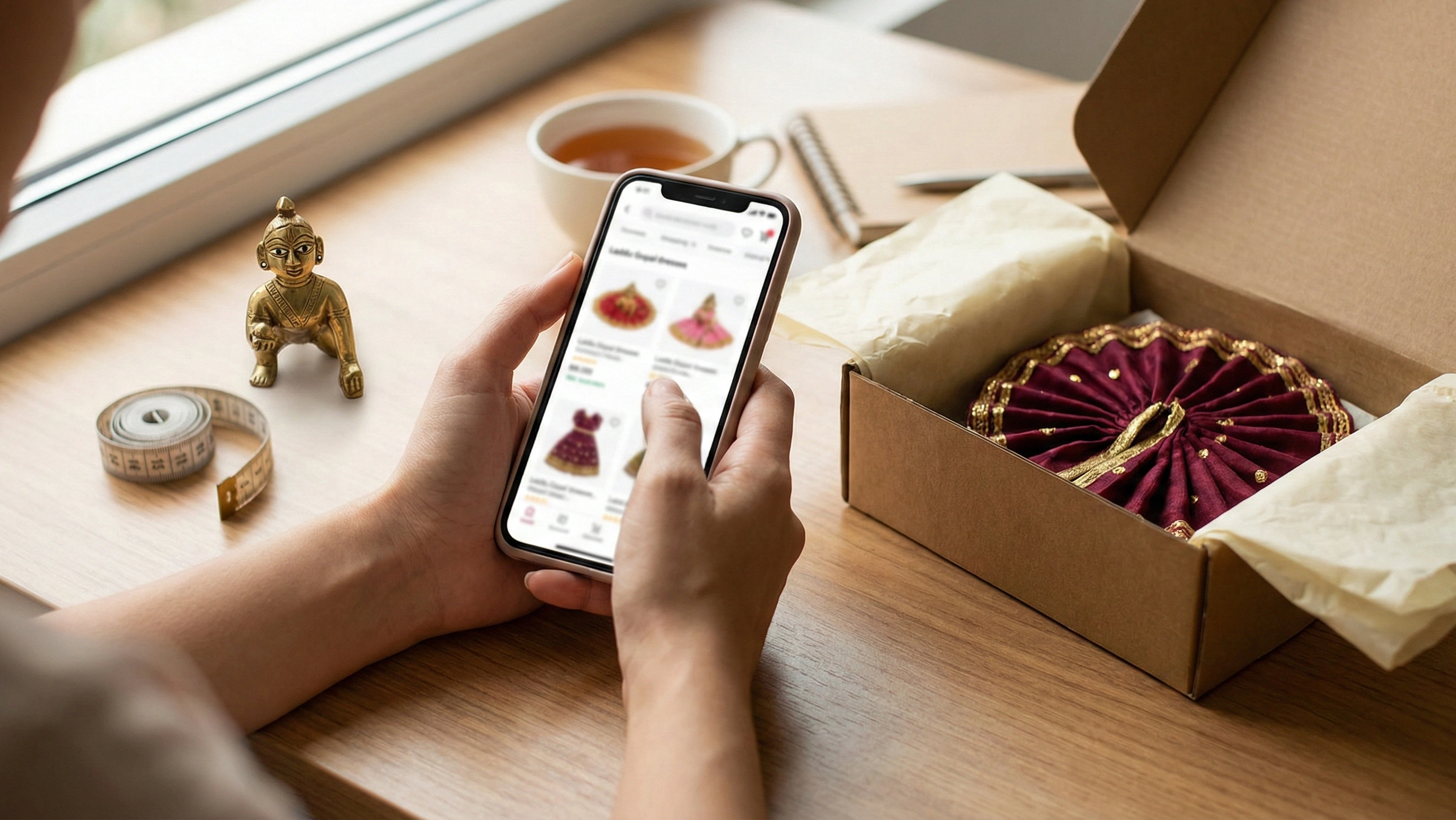
The single greatest source of disappointment in online poshak shopping is not fabric quality or delayed delivery — it is sizing. The numbering system used for Laddu Gopal idols across India is not standardised in any meaningful way. One seller's Size 3 poshak will fit what another seller calls a Size 4, and a third may use centimetre measurements entirely. The number printed on the base of your idol, if one is printed at all, is a manufacturer's reference — it does not translate directly into a poshak size. The only reliable method is to measure your Thakurji directly: height from the base of the feet to the crown of the head, chest width at the widest point, and the width across the shoulders. Write these three numbers down and carry them into every poshak conversation. Any trustworthy seller will provide a size chart with actual garment measurements — if they offer only a numbered size list with no corresponding dimensions, ask before ordering.
- Measure height from the base of the feet to the top of the head, not to the crown or mukut (crown ornament)
- Measure chest width at the widest point of the idol's body — this is the most critical fit dimension
- Measure shoulder width to ensure the poshak armholes fall correctly on the idol
- Request the seller's size chart in centimetres, not just numbered sizes
- When in doubt, size up slightly — a marginally loose poshak always looks better than one that pulls or bunches at the seams
Reading Fabric Descriptions Honestly
After sizing, fabric description is where the most misleading language in online poshak listings tends to appear. Phrases like "silk-feel fabric," "royal satin finish," "premium quality material," and "velvet-type cloth" are not fabric names — they are impressions, and they are almost always used to describe synthetic or blended materials that would not command the same price if described accurately. A seller who genuinely works with pure silk will name it plainly: Banarasi silk, Katan silk, pure mulberry silk. A seller working with genuine velvet will say so without qualification. This is not to say that synthetic or blended fabrics are wrong for a poshak — there are beautifully made pieces in polyester silk and blended velvet that photograph well and serve their purpose with dignity. The issue is paying a pure-fabric price for a blended-fabric product. Ask the specific question directly: what is the fabric composition of this poshak? A confident, specific answer is a good sign. Vagueness is a reason to hesitate.
- "Silk-feel" or "silky fabric" — likely polyester or rayon blend, not pure silk
- "Velvet-type" or "premium velvet" — may be synthetic velvet or velboa, not silk velvet or pure cotton velvet
- "Royal fabric" or "premium material" — meaningless as a fabric description; ask for the actual fibre content
- "Zari (metallic woven border) work" can mean genuine metallic zari or synthetic gold thread — for festival-grade poshak, clarify which
- Genuine pure silk listings will typically include the weave type: Banarasi, Katan, Chanderi, Tussar — these are specific, verifiable names
Tip: If a piece described as pure silk is priced significantly lower than you would expect, ask about the fabric composition directly before ordering. Genuine silk has a natural weight and drape that cannot be replicated cheaply, and a confident seller will always welcome the question.
Handcrafted Versus Machine-Made: What to Look For
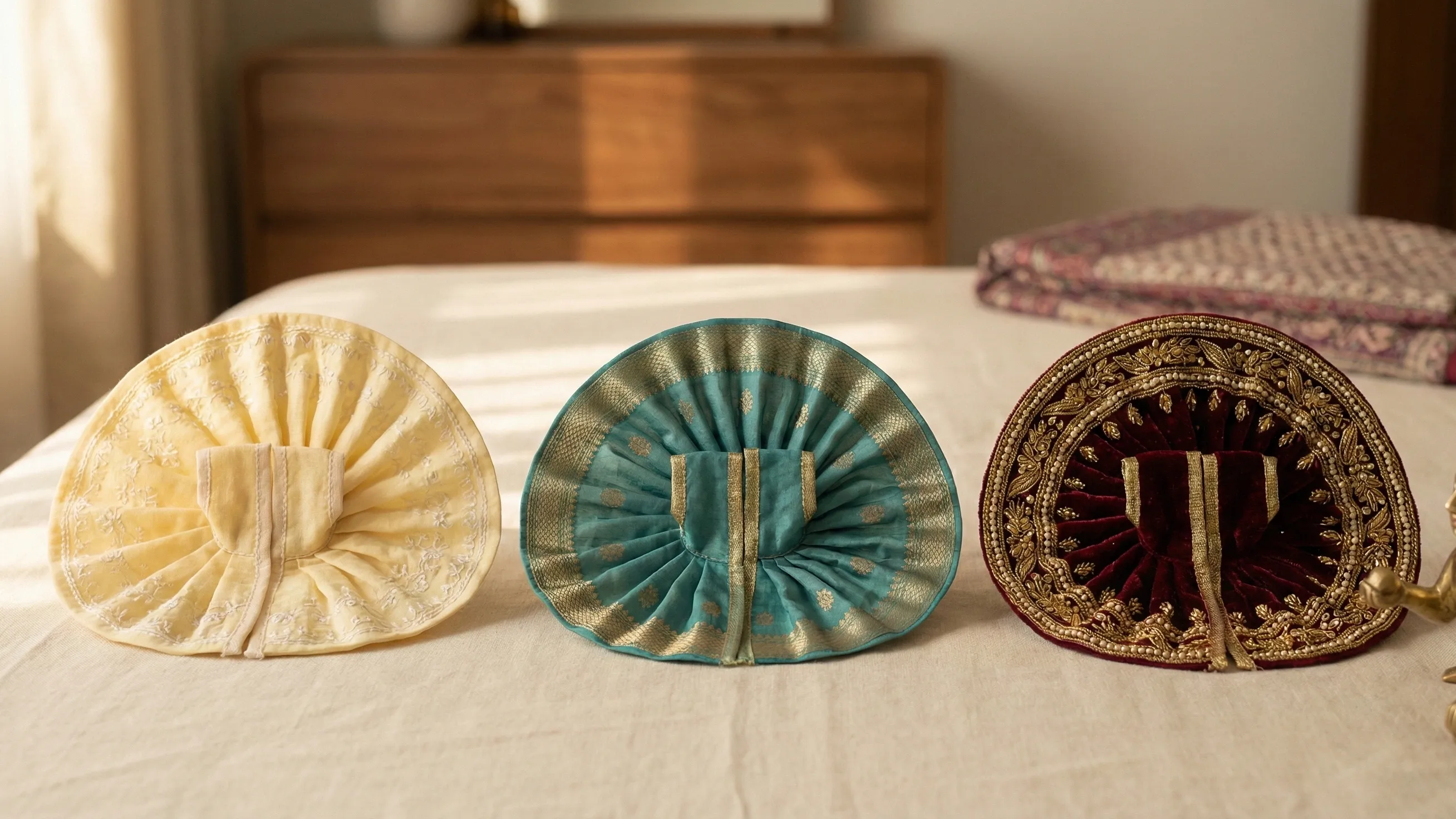
A handcrafted poshak and a machine-made one can look almost identical in a product photograph taken at the right angle and under the right light. The differences reveal themselves in the details — and knowing what those details are will help you read a product listing more accurately. Handstitched embroidery has a slight natural variation in stitch length and tension that machines cannot replicate: the irregularities are not flaws, they are the signature of a human hand working with care. Machine embroidery, by contrast, has a perfectly uniform, almost mechanical regularity — every motif is identical to the next, every stitch precisely the same depth. Neither is inherently superior; machine-made poshak at a fair price point is a perfectly respectable choice. The issue arises when a piece is described as handcrafted and charged accordingly but was produced by machine. A clear close-up photograph of the embroidery will usually tell you what you need to know: look for the subtle variations that signal hand work, or the rigid uniformity that signals a machine. If the seller cannot provide that close-up photograph on request, treat it as a reason to pause.
Using Customer Reviews as Your Research Tool
In the absence of being able to hold a poshak in your hands, verified customer reviews are the closest thing you have to a trusted friend's opinion — but only if you know how to read them. A simple five-star rating with no accompanying text tells you very little. What you are looking for are reviews that mention specific, observable qualities: the fabric felt soft and the colour was exactly as shown; the stitching held after several months of use; the size matched the chart; the embroidery did not start fraying after the first washing. Reviews that include photographs of the poshak on an actual Laddu Gopal idol are especially valuable, because they show you proportion, colour accuracy, and drape in a real-world context that a product photograph on a white background simply cannot. Negative reviews are as informative as positive ones — a consistent pattern of complaints about one specific issue, such as colour being significantly different from photographs or sizing running consistently small, is more meaningful than any single bad review.
- Look for reviews that describe the fabric texture, weight, and colour accuracy in specific terms
- Reviews mentioning sizing fit or mismatch are especially relevant — note whether complaints are isolated or consistent
- Photographs in customer reviews show real-world proportion and colour that studio product shots do not
- Check if the seller responds to negative reviews — how a seller handles complaints tells you as much as the complaint itself
- Recent reviews matter more than older ones, especially for small sellers whose quality or suppliers may have changed
Colour, Returns, and the WhatsApp Advantage
Colour is one of the most reliably unreliable things about online shopping. Every screen — phone, laptop, tablet — renders colour differently, and most product photographs are taken under studio lighting that shifts tones toward the warmer or cooler end of what the fabric actually looks like in natural light. A deep saffron can photograph as burnt orange on one device and bright yellow on another. If colour accuracy matters to you — and for a poshak you are buying to coordinate with a singhasan (throne) backdrop or a matching accessory set, it often does — always ask the seller for a photograph taken in natural daylight before confirming your order. Before placing any significant order, verify the return and exchange policy clearly. A reputable seller will state their policy without hesitation and will have a process that does not require you to navigate confusing courier paperwork alone. At Gopalji Fashion, orders are currently placed through WhatsApp, which means every conversation happens directly with the person making the poshak. You can share your Kanha Ji's measurements, ask about fabrics, request a daylight colour photograph, and discuss your specific occasion — and you will receive an honest answer rather than an automated response. The online store is coming soon, but for now, that direct conversation is something we consider part of the care we put into every piece.
Tip: When your poshak order arrives, inspect it on the same day and photograph it before putting it on your Thakurji for the first time. This protects you if there is a genuine quality issue — a seller is far better placed to help when a concern is raised immediately and accompanied by clear photographs.
Tags